
Classification of Periodontal Diseases

Contents
ToggleClassification of Periodontal Diseases
- Last updated April 21, 2026
✅ Objectives
By the end of these revision notes, you should be able to:
- Describe the categories in the classification of periodontal diseases
- Apply the staging and grading system for periodontitis
What is the Classification of Periodontal Diseases?
Until recently, UK dentists used the 1999 Armitage classification for periodontal disease. This divided periodontitis into chronic and aggressive forms. However, this system was limited due to:
- Its failure to account for disease progression and risk factors
- Its failure to manage the significant overlap between categories
As a result, in 2017, the American Academy of Periodontology (AAP) and the European Federation of Periodontology (EFP) introduced a new classification. This was then also adopted by the British Society of Periodontology (BSP), with a clearer and more clinically relevant system.
This Revision Note will describe the classification of periodontal diseases, with greater detail on periodontitis.
Categories of Periodontal Diseases
There are four broad categories as part of the classification:
1) Periodontal Health, Gingival Diseases and Conditions
- Periodontal health (intact periodontium)
- Periodontal health (reduced periodontium*)
- Gingivitis: dental biofilm-induced (intact periodontium)
- Gingivitis: dental biofilm-induced (reduced periodontium*)
- Gingival disease and conditions: non biofilm-induced – this may be due to trauma, systemic disease, genetic disorders etc.
*Reduced due to causes other than periodontitis e.g. surgery.
2) Periodontitis
- Periodontitis
- Necrotising periodontal diseases (NPDs) – (read more here)
- Periodontitis as a manifestation of systemic disease
3) Other Conditions Affecting the Periodontium
- Systemic diseases or conditions
- Periodontal abscesses and endodontic-periodontal lesions
- Mucogingival deformities and conditions
- Traumatic occlusal forces
- Tooth and prosthesis related factors
4) Peri-Implant Diseases and Conditions
- Peri-Implant health
- Peri-Implant mucositis
- Peri-Implantitis
- Peri-Implant soft/hard tissue deficiencies
Gingivitis and Periodontitis
Gingivitis is a reversible inflammation of the periodontal tissues, with no associated bone loss. This may or may not be induced by biofilm.
Periodontitis is an inflammation of the periodontal tissues that leads to irreversible bone loss. Under the new classification, periodontitis is no longer divided in to chronic and aggressive forms. The classification introduces the concept of staging and grading as part of a periodontitis diagnosis.
Staging and Grading of Periodontitis
Staging
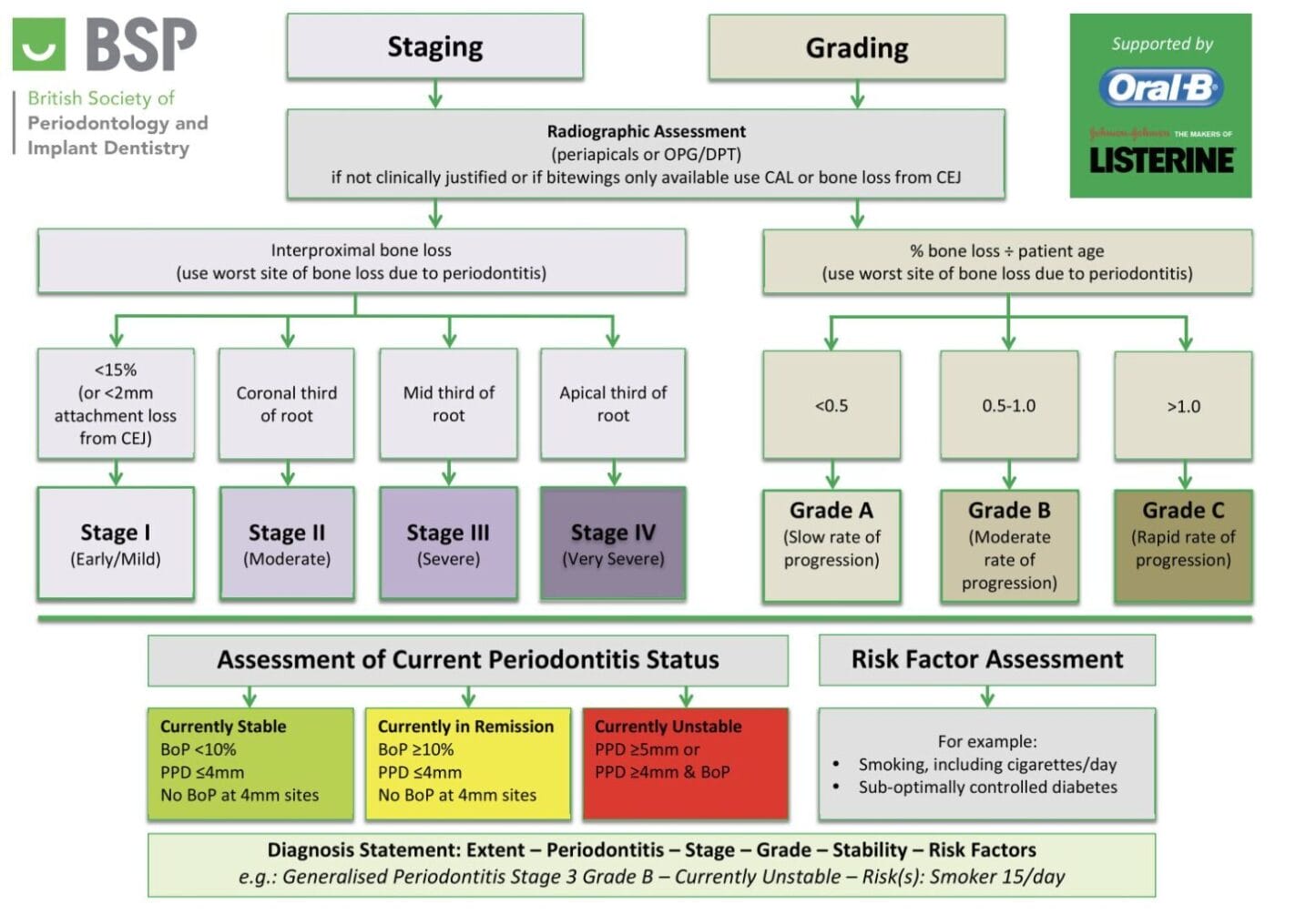
Staging addresses how advanced the periodontitis is and, potentially, how complex treatment will be. The BSP has simplified the EFP/AAP criteria slightly as follows:
- Stage I (early/mild) – <15% interproximal bone loss (IBL) or <2mm attachment loss from CEJ
- Stage II (moderate) – IBL within the coronal third of the root
- Stage III (severe) – IBL within the middle third of the root
- Stage IV (very severe) – IBL to the apical third of the root
The worst site of bone loss should be used to assess this.
Grading
Grading reflects the disease progression and, again, has been simplified for clinical application by the BSP. This is calculated by dividing the percentage bone loss by the patient’s age:
- Grade A (slow rate) – <0.5
- Grade B (moderate rate) – 0.5-1.0
- Grade C (rapid rate) – >1.0
Extent and Distribution
The extent of periodontitis is based on the percentage of teeth involved:
- Localised = <30% of teeth involved
- Generalised = ≥30% of teeth involved
- Molar/incisor pattern (the classic appearance of what used to be called aggressive periodontitis)
Risk Factors
There are two established risk factors for periodontitis described as part of the new classification – smoking and diabetes. These can be added as part of the patient’s periodontitis diagnosis.
Stability
Stability of disease will provide information on the current level of disease activity.
|
Current disease status
|
Definition
|
|---|---|
|
Stable
|
BoP < 10%
PPD ≤ 4mm No BoP at 4mm sites |
|
Remission
|
BoP > 10%
PPD ≤ 4mm No BoP at 4mm sites |
|
Unstable
|
PPD ≥ 5mm (or ≥ 4mm with bleeding at those sites)
|
 Clinical Relevance
In the UK, the Basic Periodontal Examination (BPE) is used to screen patients for periodontal disease. This is summarised with the BSP flowchart:
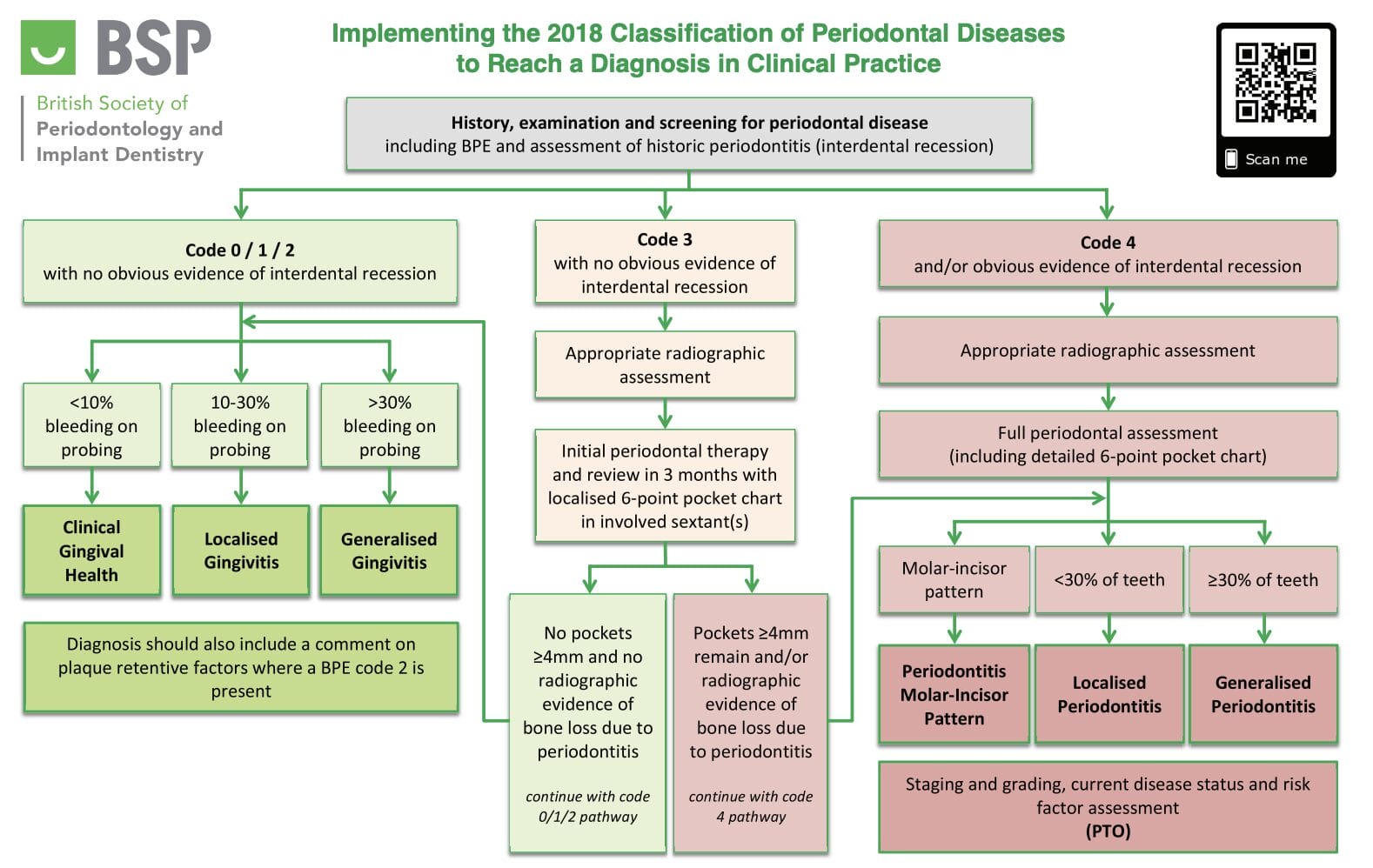
For those with periodontal disease, the diagnosis is usually broken down as follows:
- Category e.g. periodontitis
- Extent (localised, generalised or molar-incisor)
- Stage
- Grade
- Stability
- Risk factors
For example, ‘Generalised Periodontitis Stage II Grade B – Currently Unstable – Risk: Smoker 10/day’
Summary
- The overall categories in the classification of periodontal diseases include periodontal health/gingival conditional, periodontitis, other conditions affecting the periodontium and peri-implant diseases.
- Periodontitis diagnoses should include staging and grading.
- The BSP recommend using a BPE to help guide assessment and periodontal charting.

🚨 Access Restricted

Subscribe to access ALL revision notes and cheat sheets!
We provide a wide range of revision notes and cheat sheets to help you study and prepare for exams! To access all we have to offer, head over and subscribe to ExamineDental now to supercharge your revision!
🚨 Access Restricted
Upgrade to access ALL revision notes and cheat sheets!
We provide a wide range of revision notes and cheat sheets to help you study and prepare for exams! To access all we have to offer, upgrade your subscription now!

 and then